

Logistics vs Supply Chain
In modern commerce, logistics and supply chain are often mentioned together, yet they serve different purposes. While both are essential to business operations, their effectiveness depends on how well they work in alignment.
Recent global disruptions such as port congestion, rising freight costs, labour shortages, and geopolitical uncertainty have highlighted one key reality: strong planning alone is not enough. Businesses need both a resilient supply chain strategy and reliable logistics execution to remain competitive.
As global trade becomes more complex and technology-driven, understanding how logistics and supply chains function together has become a strategic necessity rather than an operational afterthought.
What is Supply Chain?
Supply chain refers to the entire ecosystem involved in bringing a product or service from its initial concept to the end customer, and even beyond.
This includes activities such as:
From an industry perspective, supply chain management has evolved significantly. It is no longer focused solely on cost reduction. Today, companies are prioritising resilience, visibility, and risk management. Many organisations are diversifying their supplier base, adopting multi-country sourcing strategies, and placing greater emphasis on sustainability and compliance.
Modern supply chains are designed not just for efficiency, but for continuity and adaptability in an unpredictable global environment.
Where Logistics Comes In
Logistics is a critical operational component within the broader supply chain. It focuses on the physical movement, storage, and coordination of goods and information to ensure plans are executed effectively.
Logistics typically covers inbound movement of raw materials, outbound delivery of finished goods, warehousing and storage, order fulfilment, tracking, and customs clearance for cross-border trade.
In recent years, logistics has become increasingly complex. Customer expectations for faster delivery have risen, regulatory requirements vary across regions, and certain cargo types, such as temperature-sensitive or high-value goods, demand specialised handling. As a result, logistics now plays a central role in maintaining service reliability and cost control.
In simple terms, logistics turns supply chain planning into real-world outcomes.
|
How Logistics and Supply Chain Work Together
Although logistics is one part of the supply chain, the two must work closely together to deliver results. Supply chain planning defines where goods are sourced, how much is produced, and where inventory is positioned. Logistics ensures that these decisions are carried out smoothly through transportation, warehousing, and fulfilment.
When supply chain teams forecast demand and inventory levels, logistics operations must adjust transport capacity, warehouse space, and delivery schedules accordingly. During disruptions, supply chain strategies focus on mitigation and continuity, while logistics teams respond on the ground through rerouting, alternative transport options, and rapid execution.
When aligned, businesses experience fewer delays, better cost management, and stronger customer satisfaction.
Here’s how they reinforce each other:
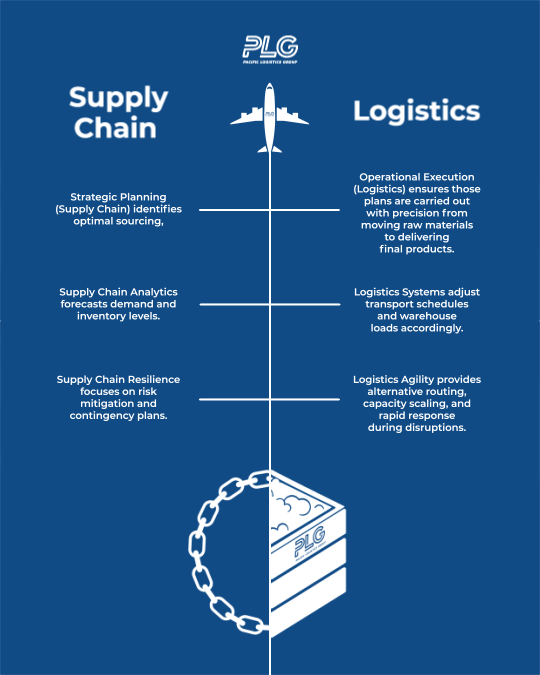
Strategic Planning (Supply Chain) identifies optimal sourcing, manufacturing, and distribution strategies.
➜ Operational Execution (Logistics) ensures those plans are carried out with precision — from moving raw materials to delivering final products.
Supply Chain Analytics forecasts demand and inventory levels.
➜ Logistics Systems adjust transport schedules and warehouse loads accordingly.
Supply Chain Resilience focuses on risk mitigation and contingency plans.
➜ Logistics Agility provides alternative routing, capacity scaling, and rapid response during disruptions.
A Simple Analogy
Think of the supply chain as the entire human body, and logistics as the circulatory system.
The brain may plan and decide, but without blood flow, nothing moves, and no function can be fulfilled. In the same way, supply chain strategy and logistics execution must work together to keep operations healthy.
|
How PLG Supports This Relationship
At PLG, we view logistics as a strategic connector within the wider supply chain, not a standalone service.
Through customised, scalable, and data-driven logistics solutions, we help businesses improve delivery reliability, optimise inventory flow, respond more quickly to market changes, and manage cross-border regulatory requirements with confidence.
Whether you are sourcing globally or distributing across ASEAN and beyond, our logistics capabilities are designed to strengthen your supply chain performance from planning through execution.